
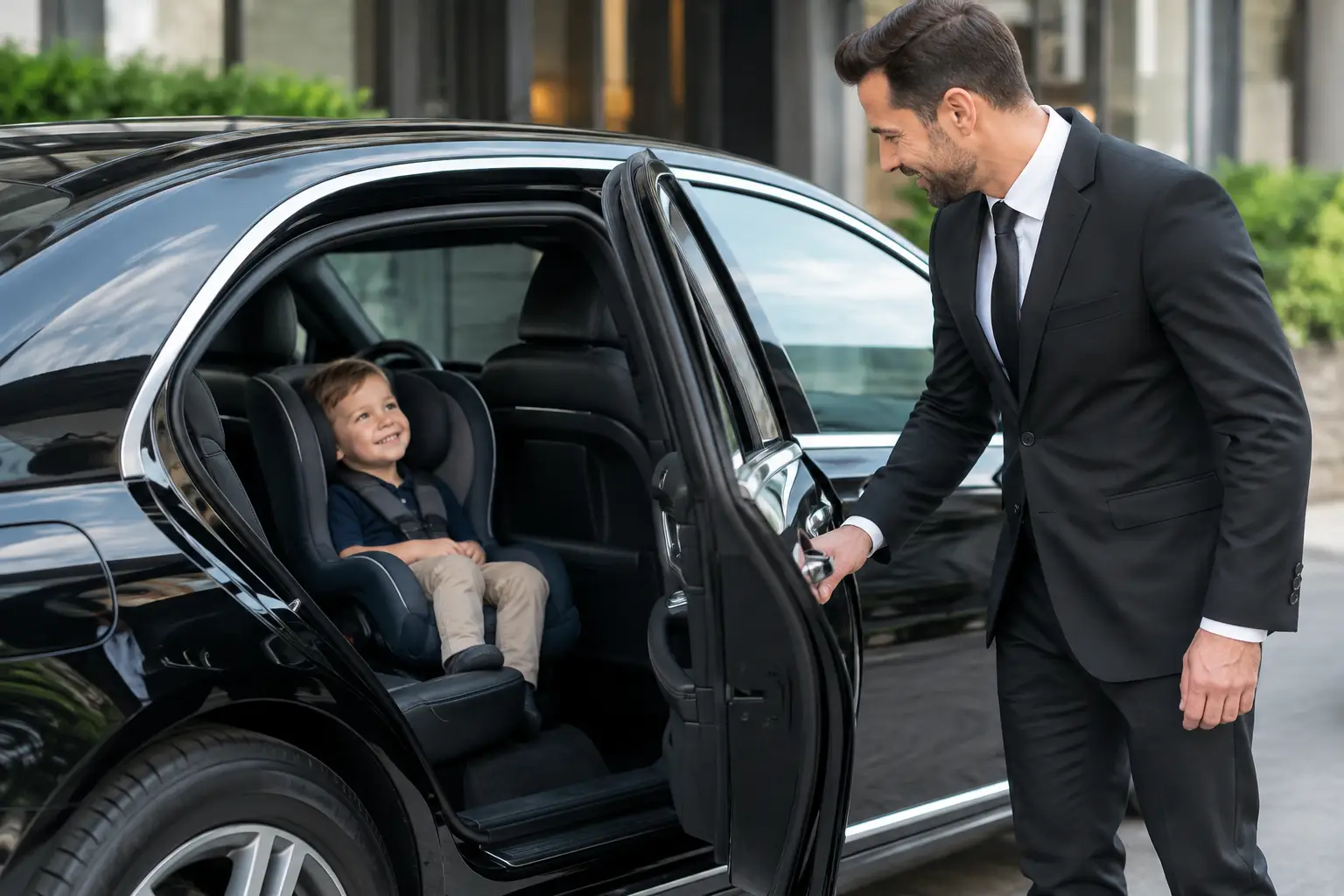
A 4am airport collection with a tired toddler is not the time to discover that a child seat has not been arranged. If you are asking, “are child seats available?”, the right answer is: ask before you book, give clear details, and have the arrangement confirmed in advance.
For family travel, a suitable child restraint is every bit as important as luggage capacity, collection time and the number of passengers. A professional private-hire journey should remove uncertainty, not leave you trying to solve it on the pavement.
Are child seats available for private hire?
Child-seat availability can vary by operator, vehicle, journey type and the age and size of the child travelling. It should never be assumed simply because you have booked a larger vehicle or informed the driver that children are in your party.
The most dependable approach is to state your requirements when requesting a quote. Share the child’s age, approximate height and weight, how many children need seats, and whether you require a rear-facing infant seat, a forward-facing seat or a booster. The booking team can then confirm whether a suitable arrangement is available for the vehicle allocated to your journey.
If a seat cannot be supplied, taking your own may be the best option. This is particularly sensible for very young children, children who need a specific seat, or longer journeys where familiarity makes a real difference. A child who knows their own seat is often more settled before an early flight, after a busy match day or on the drive home following a family event.
Why advance booking matters
A last-minute taxi can be convenient for an adult travelling light. It is less suitable when you need to account for a pram, several cases, a car seat and a child who may fall asleep minutes after setting off. Pre-booking gives everyone a chance to plan the practical details properly.
It also allows the vehicle to be matched to the journey. A family of five travelling to Liverpool John Lennon Airport with hold luggage has different needs from two adults and a baby going to Lime Street. Seven seats do not automatically mean seven passengers plus a pushchair, multiple suitcases and child restraints will fit comfortably. The space required depends on the type of seat, the amount of luggage and whether the children are travelling in rear-facing positions.
At Oakmont Executive Travel, the conversation starts before the vehicle arrives. By providing your family’s requirements at the point of enquiry, you can establish what is suitable, agree the collection plan and receive a fixed-price quotation. The quote is the fare, with no hidden extras arising from a journey that should have been planned properly from the start.
Give the right details when you book
“Child seat needed” is a useful start, but it is not enough to guarantee the right fit. Child seats are designed around a child’s size and stage, not just their age. A three-year-old may have very different needs from another child of the same age.
When arranging your journey, be ready to provide the following information:
- each child’s age, approximate height and weight
- the number and type of seats required, including whether rear-facing travel is needed
- whether you will bring your own seat or need availability checked
- the number of adults, children, cases, pushchairs and other large items
- the collection and destination details, especially for airport, cruise and rail transfers
This information helps avoid awkward compromises. It also gives the operator time to confirm compatibility with the allocated vehicle rather than making assumptions on the day.
If you are bringing your own child seat
Bringing your own seat can offer extra reassurance, especially if it is one your child uses regularly. Before you travel, check that you have the full seat, its harness or impact shield where applicable, and any instructions or fittings needed for installation. If your seat uses ISOFIX, confirm that the vehicle being supplied can accommodate it. Do not assume that every seating position has the same fittings.
You should also consider what happens at the other end of the journey. For an airport transfer, will the seat travel with you, be collected later, or be needed for your return journey? For a cruise terminal or station drop-off, can you manage it alongside luggage? These questions are not glamorous, but they make family travel noticeably calmer.
Some families choose a seat that can be carried easily for a holiday journey. Others prefer the familiar support of their everyday seat. There is no single right choice, provided the seat is suitable for the child and the plan is communicated clearly.
Safety is more than meeting the minimum
Child car-seat rules can include limited exceptions in certain circumstances, but an exception is not a family travel plan. For pre-booked private hire, arranging the appropriate restraint in advance is the safer, more comfortable choice whenever possible.
A suitable seat should be correctly installed and used as intended. Rear-facing seats need particular care, and a rear-facing child seat must not be placed in front of an active airbag. Older children using booster seats also need the vehicle’s seat belt positioned correctly across the body, rather than sitting too high on the neck or too low across the stomach.
If anything about the set-up does not look right, raise it before the journey begins. A professional driver will understand that parents need a moment to check the child is secure. It is far better to make that check at your front door than to spend the journey worried about it.
Planning airport and longer-distance journeys
Airport transfers bring extra pressure because timings are fixed and luggage is rarely light. Add a child seat to the equation and a little planning becomes essential. Tell the booking team your flight number, terminal, party size and return requirements, as well as the child-seat details. Flight monitoring and a pre-arranged collection plan can reduce the stress if your arrival time changes.
For an outbound journey, allow a few extra minutes at collection. Children take time to settle, and parents often have last-minute items to load: snacks, coats, tablets, buggy clips and passports that seem to vanish at the crucial moment. A well-planned collection should feel unhurried, even when the morning is not.
Longer trips across the North West or mainland UK call for the same care. A premium people carrier can provide the comfort, luggage space and room for a family to travel together, but the exact seating layout still needs to work around the restraints required. Give the full picture before accepting a quote.
Do not rely on assumptions about vehicle size
A larger vehicle is valuable for families, but its size alone does not determine child-seat suitability. The position of seat belts, available anchoring points, access to the rear row and the shape of the seat base can all affect installation. A pram or several large cases may also change where passengers can sit.
This is why direct booking is so useful. Instead of selecting a generic vehicle category on an app and hoping for the best, you can speak to a local team, explain the journey and receive a considered answer. For group travel, more than one vehicle may be the most comfortable and practical solution, particularly where several young children and luggage are involved.
A calmer start for the whole family
The value of arranging child seats properly is not limited to safety. It changes the feel of the journey. Parents can focus on getting everyone out of the house, children have a secure and familiar place to sit, and the driver arrives knowing what the party needs.
Whether you are heading to the airport before sunrise, collecting relatives from the station or travelling to a wedding with children in tow, make the child-seat conversation part of the booking rather than an afterthought. The best family journeys begin with the small details already taken care of.