
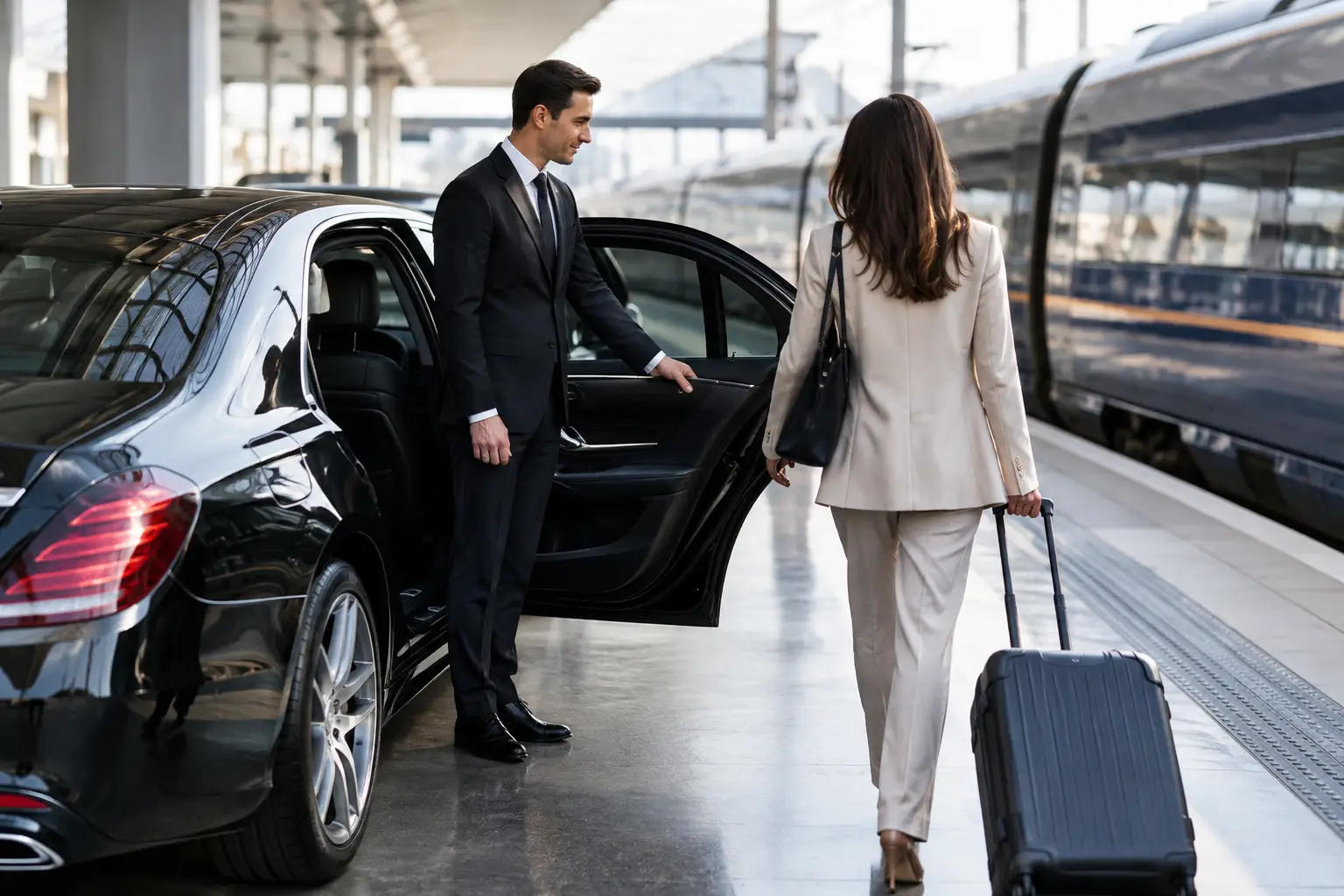
Liverpool Lime Street can be busy at the best of times. Add heavy cases, children, a late-evening arrival or an important meeting across the city, and the last thing you need is to be standing outside comparing taxi prices. Knowing how to arrange rail transfers before you travel gives you a driver, a vehicle and a clear plan waiting at the other end.
A pre-booked rail transfer is not just for executive travellers. It is a practical way to make a rail journey feel properly organised, whether you are returning home after a holiday, meeting relatives, travelling to a cruise terminal or taking colleagues to a client appointment. The key is sharing the right details and allowing enough time for the real journey, not just the train timetable.
Start with your train, not your estimated arrival time
When arranging a collection from a station, give your transport provider the train service details as well as the scheduled arrival time. Include the departure station, train operator, service number if available and the station where you are arriving. This makes it much easier to identify the journey if the timetable changes.
Do not book a car for the exact minute your train is due to arrive. Even when a service is on time, you may need a few minutes to leave the carriage, collect luggage, help a child, find the lift or make your way through an unfamiliar station. For most rail transfers, allowing 15 to 20 minutes after scheduled arrival is sensible. At larger stations, during peak periods or when travelling with a group, a little more time removes unnecessary pressure.
The same thinking applies when travelling to the station. Work backwards from your train departure, then allow time for traffic, finding your platform, buying refreshments and any assistance you may need. If you have an Advance ticket tied to a specific service, missing that train can be more than inconvenient. A professional driver plans the road journey around the time you need to be on the platform, not simply the time the train leaves.
How to arrange rail transfers with the right information
A good booking should feel straightforward, but details matter. Giving them in advance means your driver can arrive prepared and you are not trying to explain the journey over the phone while carrying luggage on a platform.
When you request a quotation, have these essentials ready:
- The collection date, train times and stations involved
- Your preferred pick-up point, including the postcode for home, hotel or office collections
- The number of passengers, including children who may need suitable seating
- The amount and type of luggage, particularly large cases, prams, golf bags or mobility equipment
- A mobile contact number and any access, mobility or meeting requirements
For a station collection, agree the meeting point before the day of travel. Some stations have short-stay pick-up areas, designated private-hire bays or clear main entrances. Others are easier to navigate from a nearby street. A named meeting point prevents the familiar problem of passenger and driver being only a minute apart, but unable to see one another.
If you are arriving on a late service, ask how your provider handles delays and changes. Trains can be held outside stations, diverted or cancelled with little warning. Keep your provider updated where possible, especially if you are moved on to another service. Clear communication gives everyone the best chance of adjusting the collection without confusion.
Choose a vehicle around the journey
The right vehicle is about more than passenger numbers. Two people travelling with two large holiday cases need a different amount of space from two people carrying overnight bags. A family with a buggy may need extra room, while a group heading to a match or concert may want everyone to travel together rather than splitting into separate cars.
For up to seven passengers, a Mercedes-Benz V Class offers the space to travel comfortably with luggage and without the cramped feeling common in a standard taxi. It is particularly useful for airport-to-rail connections, cruise transfers, corporate groups and family journeys. Features such as Wi-Fi, refreshments and onboard entertainment can also make a longer onward journey more enjoyable, especially after a tiring train ride.
There is a trade-off to consider. A larger premium vehicle gives more comfort and capacity, but it may cost more than a standard saloon for a solo passenger with a small bag. The best choice depends on the distance, your luggage, the number of people travelling and how much value you place on travelling together. Ask for an honest recommendation rather than booking the biggest vehicle by default.
Book a fixed fare and know what it covers
A rail transfer should not end with an unexpected price change because a busy arrival hall delayed you by a few minutes. Before confirming, ask for a fixed quotation and check what is included. The quote should cover the planned journey, collection point and destination, with any waiting-time policy clearly explained.
This matters most for longer trips across the North West or mainland UK, where app-based fares can rise sharply at busy times. With a pre-booked private-hire service, the quote is the fare. That gives families, business travellers and organisers a clear cost before the journey begins, with no hidden extras appearing at the kerbside.
It is also worth confirming whether the fare includes parking or station access charges where these apply. A professional provider will explain this upfront rather than leaving you to guess. Transparency is part of dependable travel, particularly when you are arranging transport for clients, elderly relatives or a group with a set budget.
Make allowances for business, family and group travel
Business rail transfers require punctuality, privacy and a professional arrival. If a colleague or client is travelling into Liverpool, provide their mobile number and a simple description of the meeting point. A chauffeur-driven collection allows them to step off the train and continue directly to the office, hotel or meeting venue, without working out local transport after a long journey.
For families, think through the practical moments that can slow things down. Children may be tired, luggage may be awkward and station lifts may be busy. Booking door-to-door travel means there is no extra walk to a bus stop or a search for a car in poor weather. Let the provider know about child seats or other requirements when you book, rather than assuming these can be supplied at short notice.
Groups need early planning. Six or seven people travelling together can be far easier to manage in one suitably sized vehicle, but availability is naturally more limited than for a standard car. For weddings, sporting fixtures, concerts or cruise departures, book as soon as train plans are confirmed. If your party is larger, a reputable local operator can coordinate multiple vehicles so everyone arrives with a clear collection plan.
Do not forget the return journey
The most convenient rail transfer is usually a return booking arranged at the same time. You will know who is collecting you after the event, meeting or onward train, and you will not need to make transport decisions when you are tired or pressed for time.
For return travel, share the train departure time and the point you need to leave from. If you are attending a concert, match or formal event, allow for crowds leaving the venue and road closures around the area. A driver who knows the local routes can plan a sensible collection point rather than waiting where access will be difficult.
Oakmont Executive Travel provides pre-booked rail transfers across Liverpool, the North West and mainland UK, with licensed, DBS-checked drivers, insured vehicles and 24-hour availability. Whether the journey is early, late or involves several passengers, the aim is simple: a comfortable car, a professional driver and a plan that holds up when travel is busy.
Before you confirm your next train ticket, take two minutes to arrange the onward journey too. A clear pick-up time, the right vehicle and a fixed fare can turn a crowded platform into the final short step of a well-managed trip.