
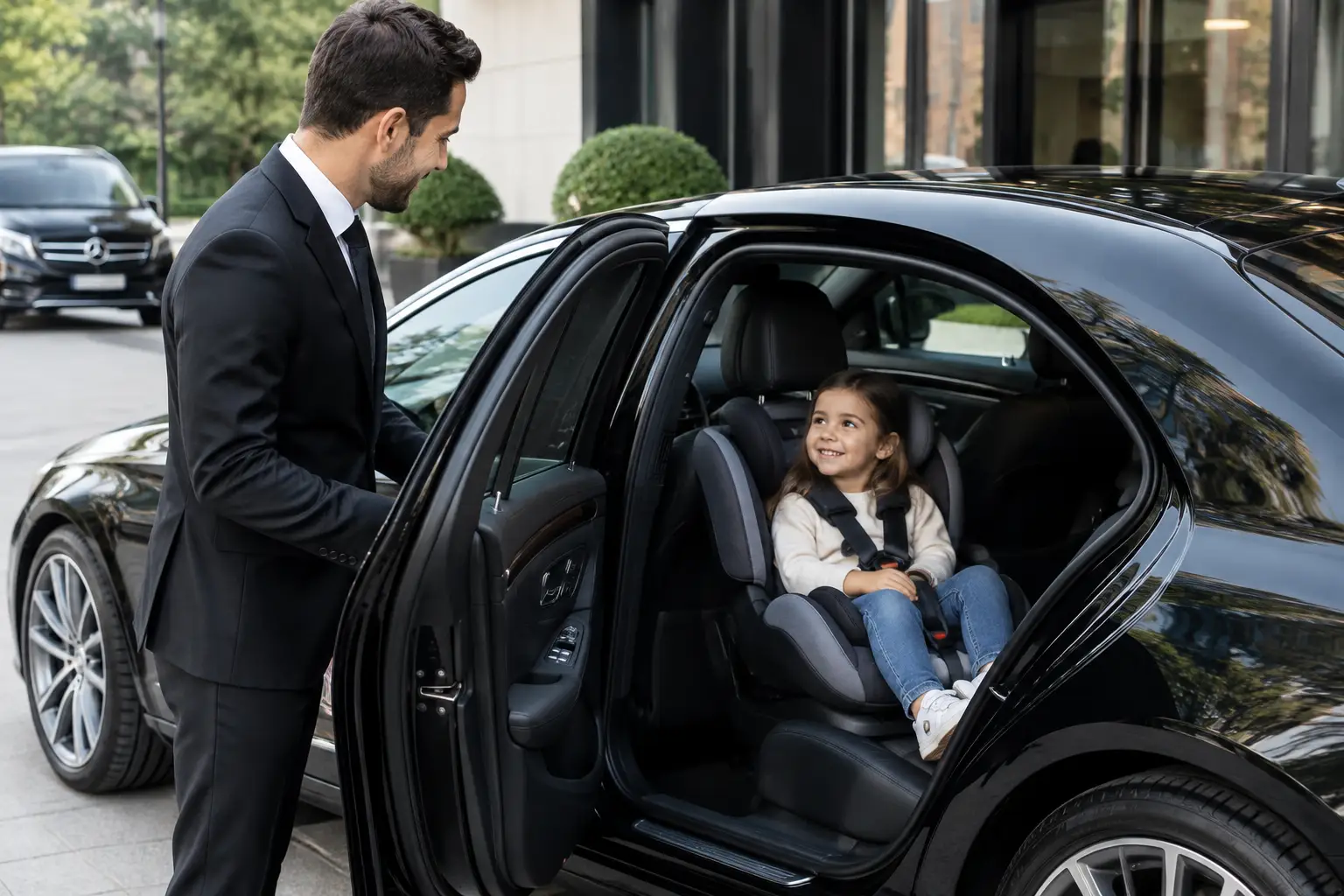
A 4.30am airport pick-up, a sleeping toddler and three suitcases can turn a simple journey into a logistical test. The safest way to transport children with car seats is to make the seating plan part of the booking, not an afterthought at the kerb. When every passenger has the right restraint, enough room and a clear pick-up time, the journey begins calmly.
For families travelling from Liverpool, across the North West or further afield, private hire can remove much of the pressure. However, a premium vehicle and a professional driver do not replace the need to choose, fit and use a suitable child car seat correctly. A little preparation protects your child and gives the driver the information needed to provide the right vehicle for your party.
Start with the child, not the vehicle
The right car seat depends on your child's height, weight and age, as well as the vehicle you are travelling in. An infant needs a rear-facing seat that supports their head and neck. Older children may need a high-backed booster seat until the adult seat belt sits correctly across the shoulder and hips.
In the UK, children must normally use a child car seat until they are 12 years old or 135cm tall, whichever comes first. After that, they must use an adult seat belt. The safest choice is not always the smallest or easiest seat to carry. It is the approved seat that fits your child properly and can be secured safely in the booked vehicle.
Before travelling, check the seat's label and instructions. Modern i-Size seats are selected by height, while other approved seats may use a weight range. Do not move a child into the next stage simply because they look cramped or because a booster seems more convenient for a short journey. Rear-facing travel remains the safer option for younger children for as long as their seat permits it.
Transport children with car seats in private hire
A licensed taxi or private-hire vehicle has limited legal exemptions where a suitable child restraint is unavailable. Those exemptions should be treated as a last resort, not a family travel plan. For example, a child under three may travel in the rear without a child seat only when one is not available, while a child aged three or over can use an adult belt in the rear in certain circumstances.
That may be lawful, but it is not equivalent to travelling properly restrained. A pre-booked family journey gives you time to avoid this compromise. Never assume that a vehicle will carry a child seat as standard, and never plan to hold a child on an adult's lap. In a sudden stop or collision, an adult cannot safely restrain both themselves and a child.
The practical answer is to tell the operator exactly what you need before confirming the journey. Some families prefer to bring their own familiar seat, particularly for infants and children with specific seating needs. Others may ask whether an appropriate seat can be arranged. Availability, fit and suitability can vary, so clear details matter.
When booking, provide the children's ages, heights and, where useful, weights. Confirm how many car seats are needed, whether they are rear-facing or forward-facing, and whether you will bring them yourself. Also mention prams, buggies, travel cots and luggage. These details affect both the seating layout and the space required in the vehicle.
Check how the seat will be fitted
Not every child seat fits every rear seat in the same way. Some use ISOFIX connectors, while others are secured using the vehicle's three-point seat belt. A large rear-facing seat may take up more room than expected, particularly when fitted behind a taller front passenger. A booster seat may be simple to carry but still needs a properly positioned belt and a supportive vehicle seat.
If you are bringing your own seat, bring the instructions too, especially if it is not used often. Allow a few extra minutes at collection to fit and check it without rushing. The harness should be snug, with no bulky coats underneath, and the seat should be fitted according to its manufacturer guidance.
For more than one child, discuss the arrangement in advance. Three seats across a rear row are not always possible, even in a larger vehicle. Likewise, a vehicle with space for seven passengers does not automatically mean it has room for seven people, several large seats and airport luggage. There is often a trade-off between passenger capacity, comfort and boot space. The right solution may be a larger vehicle, a different seating configuration or an additional vehicle for a larger family group.
Plan airport journeys around real family timings
Airport travel adds details that are easy to underestimate. Car seats, hand luggage, pushchairs and tired children all take longer to load than a standard pick-up. A professionally planned transfer should allow time for this, rather than making the family feel hurried before the journey has begun.
For an outward flight, build in time to fit seats, load bags and settle children before setting off. For a return journey, make sure the car seats will be available after landing. If you have taken your own seats on holiday, tell the driver where they will be stored during the journey. If seats are being arranged for collection, reconfirm the children's details before departure and include your flight number so collection can be managed around the actual arrival time.
Longer trips need a little more thought. Younger children may need a comfort break, snacks or entertainment within reach. Pack these separately from the main luggage. Keeping water, wipes, medication and a spare layer close by is far more useful than having them buried beneath cases in the boot.
Choose a service that welcomes the questions
Family transport should not rely on guesswork. A dependable private-hire provider will ask sensible questions, confirm the vehicle and make the fare clear before the journey. You should know who is collecting you, when they will arrive and what has been agreed for the children.
At Oakmont Executive Travel, family bookings are handled as managed journeys, with the practical details discussed before travel. That can include passenger numbers, luggage, requested child-seat arrangements and the best vehicle for the group. Licensed, DBS-checked drivers and insured vehicles provide valuable reassurance, but the booking conversation is where a safe family journey really starts.
Fixed pricing matters here too. Families should be able to plan their journey without worrying about a changing fare while they are dealing with bags, children and flight times. The quote is the fare, with no hidden extras added because the journey takes longer than expected.
A final check before you leave
Before the vehicle moves, take a moment to check each child rather than relying on a quick glance. Make sure the seat is secure, the harness is correctly fastened, the belt is not twisted and there are no heavy coats affecting the fit. Older children should understand that their belt stays on throughout the journey, even when they are sleepy after a late flight or an exciting day out.
The best family transfer is one where nobody needs to think about the road once the doors close. Give the seating plan the same attention as your flight time or hotel booking, and your children can travel in the comfort and protection they deserve.